
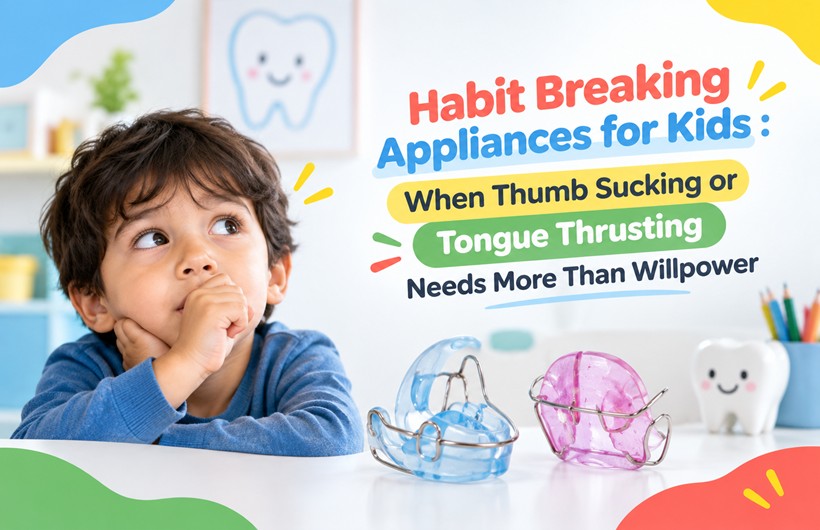
Habit Breaking Appliances for Kids: When Thumb Sucking or Tongue Thrusting Needs More Help
If your child is still sucking their thumb or thrusting their tongue against their teeth well past their fourth birthday, you’ve probably already tried the usual things. Reminders, a bandage on the thumb, a sticker chart, maybe even a stern talking-to. And the habit is still there.
That’s when parents start asking us about a habit breaking appliance for kids. It’s a small dental device, and for the right child at the right age, it works far better than willpower alone. As a pediatric dental clinic in Ahmedabad, we see this question often enough that we wanted to walk you through it properly, so you know what it actually is before you decide anything.
We’ll be honest with you upfront: not every child who sucks their thumb needs an appliance. Most grow out of it on their own. This is for the ones who don’t.
Why Do Thumb Sucking and Tongue Thrusting Become a Problem?
Sucking is a natural reflex. Babies do it in the womb, and most toddlers do it to self-soothe. It’s not something to panic about at age two or three.
The concern starts when the habit continues past the point where a child’s permanent teeth are getting ready to come in, usually around age 4 to 6. At that stage, the constant pressure from a thumb, finger, or tongue pushing against the roof of the mouth and the front teeth can start to reshape how the jaw and teeth grow.
Over time, this can lead to an open bite (where the front teeth don’t meet when the mouth is closed), a narrow upper jaw, or a tongue that has learned to push forward every time your child swallows or talks. None of this happens overnight, but the longer the habit continues, the more likely it is that orthodontic treatment will be needed later to correct it.
If you want to understand the specific dental changes this habit causes, we’ve covered that in detail in our post on thumb sucking effects on teeth.
What Is a Habit Breaking Appliance and How Does It Work?
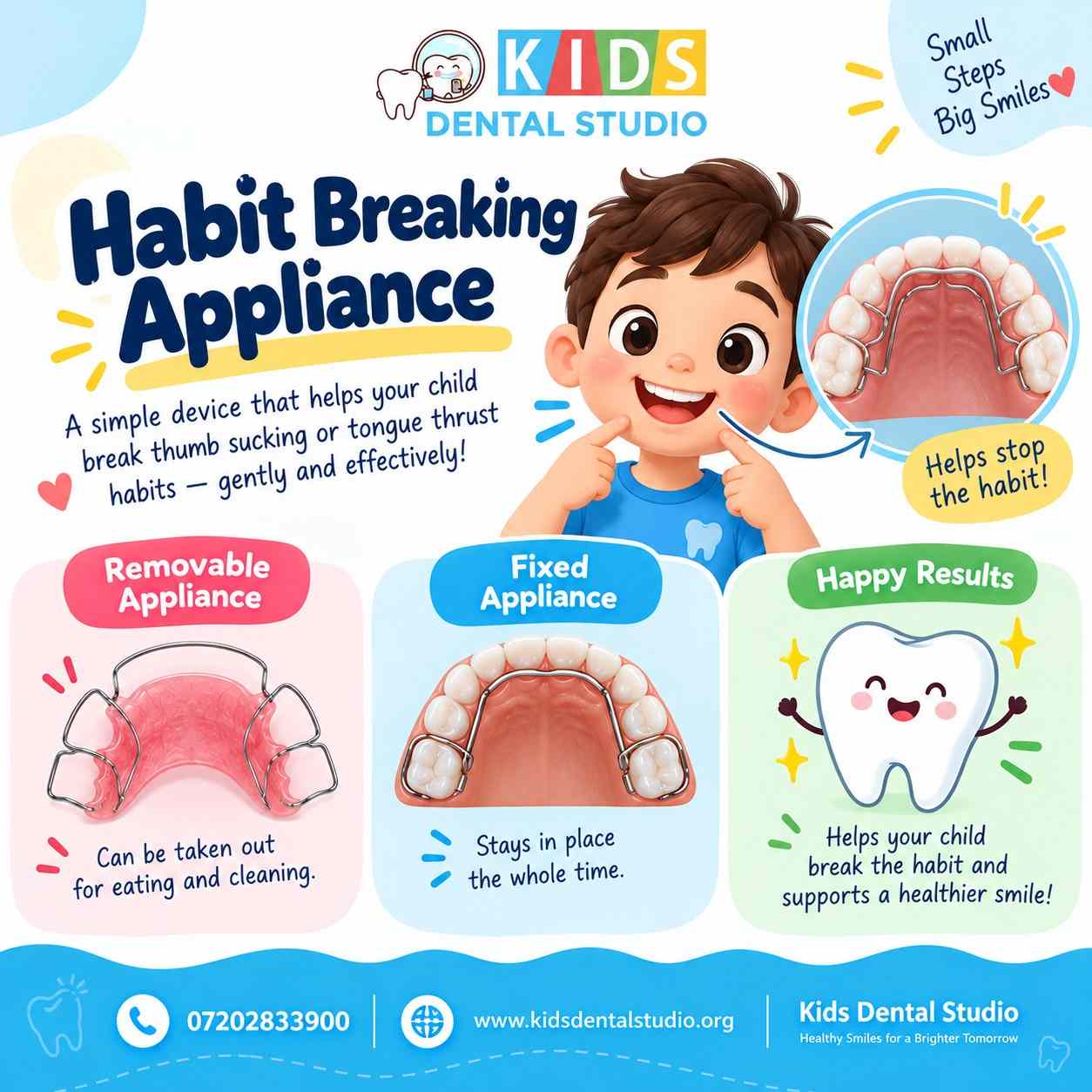 A habit breaking appliance is a small device, usually made of thin dental wire and acrylic, that sits in the roof of the mouth. It doesn’t hurt, and it isn’t a punishment. What it does is create a physical barrier so the tongue or thumb can no longer make comfortable contact with the back of the front teeth or the palate.
Without that contact, the habit stops feeling satisfying. Most children lose interest in the habit within a few weeks of wearing it, simply because it no longer gives them the same sensation.
There are two broad types:
- Removable appliances, which look a bit like a retainer and can be taken out for eating and cleaning. These depend on the child actually wearing it consistently.
- Fixed appliances, cemented onto the back molars, stay in place the whole time. These are usually recommended for children who can’t or won’t keep a removable device in.
Some children need a simple reminder-style device. Others, especially those with a stronger tongue thrust or an open bite already forming, may need one combined with a palatal expander to widen the upper jaw at the same time.
Does My Child Actually Need One?
This is usually the first question parents ask, and it’s a fair one. In our experience, an appliance is worth considering when:
- The habit is still active past age 4 to 5, especially once permanent front teeth are erupting
- You’re already seeing a gap or open bite forming in the front teeth
- Counselling, reminders, and reward-based approaches haven’t worked after a genuine attempt
- A speech pattern has started to change because of the tongue’s resting position
If your child is younger than this, or the habit is already fading, we’ll usually recommend watching and waiting instead. We won’t recommend an appliance your child doesn’t need, and we’ll tell you honestly if a few more months of encouragement at home is likely to do the job.
What Should We Try Before an Appliance?
Most pediatric dentists, us included, follow a step-by-step approach rather than jumping straight to a device. It usually looks like this:
- Direct, calm conversation with your child about the habit, without shame or punishment
- Reminder therapy, such as a bitter-tasting (child-safe) nail polish or a bandage on the thumb
- A reward system that celebrates habit-free days rather than punishing lapses
- An appliance, only if the above steps haven’t worked after a fair trial
Skipping straight to step four rarely goes well, mainly because the child hasn’t had a chance to build the motivation to stop on their own first. The appliance works best as a tool that supports a decision your child has already started to make, not as a first resort.
What Happens During Treatment?
Once we’ve assessed your child and decided an appliance is the right next step, the process is straightforward. We take an impression of your child’s mouth, the appliance is custom-made to fit, and we place it in a short in-clinic visit.
For the first few days, some children notice mild soreness in the tongue or a slight change in how words sound. This settles quickly as they adjust, usually within a week or two. We schedule follow-up visits to check fit and progress, and most children stop the habit within one to three months of consistent wear.
Conclusion
A prolonged thumb sucking or tongue thrusting habit isn’t something to feel guilty about as a parent, and it’s rarely something a child can simply be told to stop. A habit breaking appliance for kids gives them the physical support to let go of a habit their willpower alone hasn’t been able to break, while protecting the way their teeth and jaw are developing.
Best Pediatric Clinic in Ahmedabad
If your child’s habit has persisted past the age where it usually fades, it’s worth getting it looked at rather than waiting to see what happens. Call us or book an appointment with Kids Dental Studio, and we’ll assess whether your child needs an appliance or just a bit more time.
Frequently Asked Questions
Q: At what age should I be concerned about my child’s thumb sucking?
A: Occasional thumb sucking before age 4 is usually not a concern. If the habit is still frequent past age 4 to 5, especially as permanent teeth begin coming in, it’s worth having it evaluated.
Q: Will a habit breaking appliance hurt my child?
A: No. It may feel unusual for the first few days, and some children have mild tongue soreness or a slight lisp initially, but it is not a painful device.
Q: Can my child eat normally with the appliance in?
A: Yes, most children adjust to eating comfortably within a few days. We’ll go over any specific food guidance based on the type of appliance used.
Q: How long does my child need to wear it?
A: This varies by child, but most habits stop within one to three months of consistent wear. We monitor progress at follow-up visits and remove it once the habit has stopped.
Q: What if my child keeps taking a removable appliance out?
A: If a removable device isn’t working because of compliance, we may recommend switching to a fixed appliance instead, since it doesn’t rely on your child remembering to wear it.
Q: Will the teeth correct themselves once the habit stops?
A: Minor changes often self-correct once the habit ends, especially in younger children. More significant changes, like a developed open bite, may need orthodontic evaluation separately.
Leave a replyThis article is for informational purposes only and does not constitute medical or dental advice. Every child’s dental development is different. Please consult a qualified pediatric dentist for a diagnosis and treatment plan specific to your child.