
Silver Diamine Fluoride for Kids: A Filling-Free Way to Stop Cavities
If your child just got a cavity and the thought of them sitting through a filling makes your stomach drop, you’re not alone. Most parents we see feel some version of this, especially with toddlers who can’t yet sit still for a full procedure, or kids who’ve had a rough dental experience before.
There’s an option worth knowing about before you assume a filling is the only path forward: silver diamine fluoride, or SDF. It’s a liquid that’s brushed directly onto a cavity to stop it from getting worse, no drilling, no needles, no sitting still for 20 minutes. It’s one of several approaches we use as part of pediatric dental treatment at our clinic, and it’s especially useful for young or anxious children.
It’s not right for every cavity, and it’s not a replacement for a filling in every case. But for the right situation, it can buy real time, sometimes years, before more invasive work is needed. If you’re researching options as a pediatric dental clinic in Ahmedabad, this is one worth understanding.
What Actually Happens During a Silver Diamine Fluoride Application?
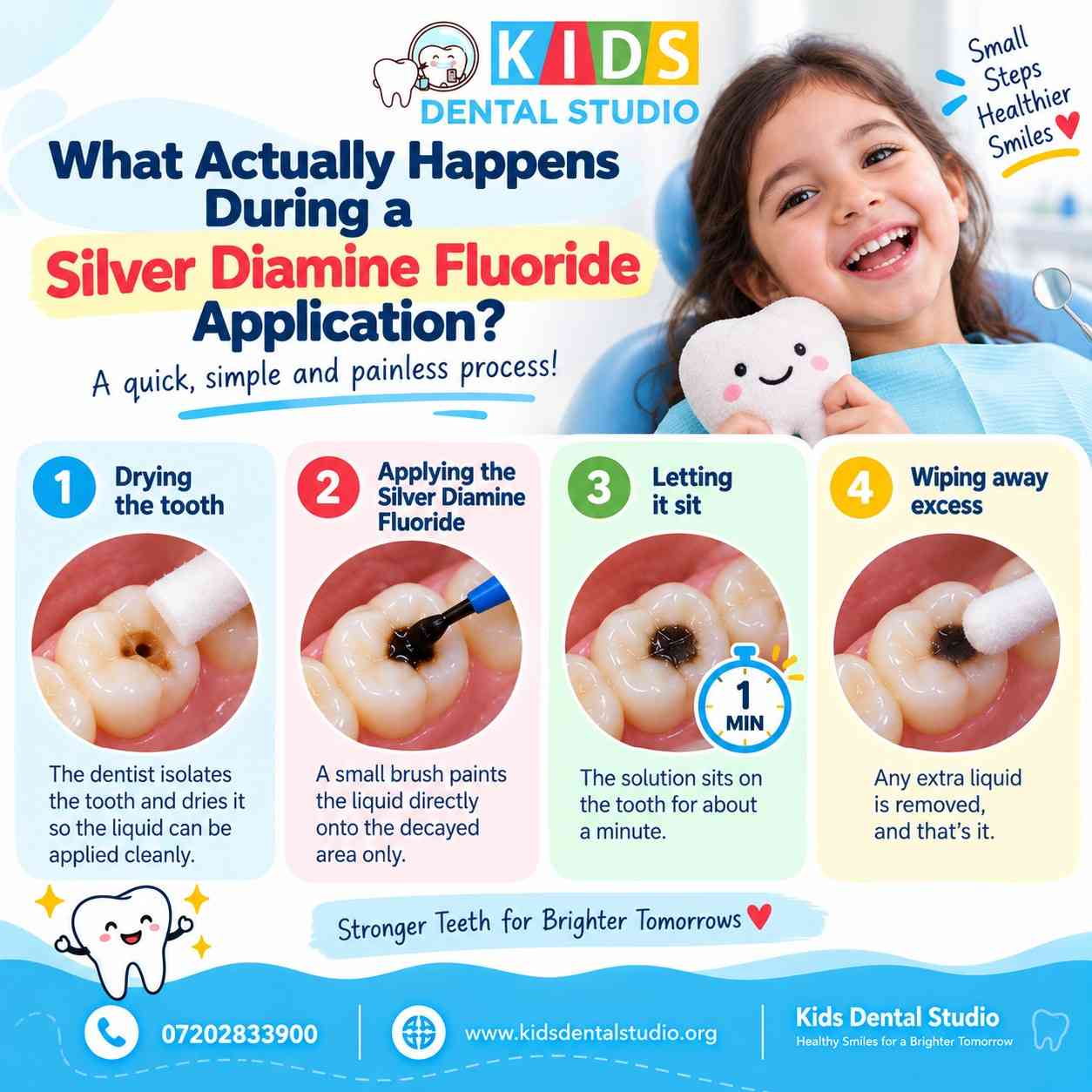 The whole process is quick and doesn’t require much from your child beyond sitting for a few minutes. Here’s what a typical appointment looks like:
- Drying the tooth. The dentist isolates the tooth and dries it so the liquid can be applied cleanly.
- Applying the SDF. A small brush paints the liquid directly onto the decayed area only.
- Letting it sit. The solution sits on the tooth for about a minute.
- Wiping away excess. Any extra liquid is removed, and that’s it.
Most kids are done in under five minutes of actual treatment time. There’s no numbing, no drilling, and no sound of the dental drill, which is often the biggest source of a child’s fear in the first place. Some kids don’t even need to be reclined in the chair for it.
The one visible side effect: SDF turns the decayed part of the tooth black. This only happens where there’s active decay; healthy enamel isn’t affected. For a back molar this is rarely a cosmetic concern. For a front tooth, it’s something we’ll talk through with you before treatment, since it is permanent on that spot until the tooth is treated further or falls out naturally.
Why Would a Dentist Choose Silver Diamine Fluoride Over a Filling?
A few situations come up often in our practice:
- Age. Your child is too young to tolerate a filling comfortably, and general anesthesia isn’t something you want to consider yet. SDF stops the decay from progressing while your child grows old enough for other options.
- A tooth that’s coming out soon anyway. The cavity is on a baby tooth that will naturally fall out in the next year or two, and a full filling isn’t worth the stress it would cause.
- Dental anxiety. Your child has significant fear of the dentist and needs a few low-stress visits to build trust with the dental team before attempting a more involved procedure.
- Multiple cavities at once. Treating all of them with fillings in one sitting isn’t realistic, so SDF manages the most urgent ones first.
In each case, SDF isn’t necessarily the final step. It’s a way to arrest the decay, meaning it stops progressing, while giving you and your child a less stressful path forward. For deeper or more extensive decay, our fluoride application treatments may also be part of the broader prevention plan, alongside SDF where appropriate.
Does Silver Diamine Fluoride Work as Well as a Filling?
For arresting existing decay, research has shown SDF to be highly effective, studies report success rates well above 70% at stopping cavity progression when applied correctly and reapplied on schedule. That’s a strong number, but it comes with a caveat: SDF doesn’t restore the tooth’s shape or fill the hole. If a cavity has already caused significant structural damage, or if your child bites down in a way that puts pressure on the treated area, a filling or crown may still be the better long-term solution.
We’ll always tell you honestly when SDF is a genuinely appropriate holding measure versus when it’s likely to just delay a treatment your child will need anyway. Our goal isn’t to avoid fillings altogether. It’s to choose the option that’s least stressful and most appropriate for your specific child’s tooth, age, and behavior at the dentist.
If you’ve already read our post on how to remove cavities from kids’ teeth, SDF fits in as one of the earliest, least invasive options on that spectrum, usually considered before a filling, not instead of proper long-term care.
Is Silver Diamine Fluoride Safe for Young Children?
Yes. SDF has been used in dentistry for decades and is considered safe for children, including toddlers. A few things worth knowing:
- Allergies. Silver allergies are rare, but we’ll ask about this beforehand.
- Staining risk. The solution can temporarily mark fabric or skin on contact, so we apply it carefully to avoid this.
- No sedation needed. It doesn’t require sedation or involve needles.
- Established track record. It has a well-established safety profile in pediatric use worldwide.
For parents specifically looking for a lower-stress cavity treatment for toddlers, this is usually the first thing we discuss.
What Should Parents Expect After Treatment?
A few quick things to know once the appointment is done:
- The black spot is permanent on that tooth unless it’s later restored with a filling or crown, or it’s a baby tooth that eventually falls out.
- No downtime. Your child can eat and drink normally within a short period after the appointment (we’ll give you a specific window based on the tooth treated).
- Reapplication is normal. SDF often needs to be reapplied every six months or so to keep the decay from restarting, so this isn’t usually a single-visit fix.
We’ll build reapplication into your child’s regular check-up schedule if this is the direction we take together.
Conclusion
Silver diamine fluoride isn’t the right call for every cavity, but it’s a genuinely useful tool for stopping decay in its tracks, especially when a filling isn’t realistic yet for your child’s age or comfort level. It won’t restore a tooth’s shape, and it isn’t meant to replace every filling your child will ever need. What it does offer is a low-stress way to pause decay and protect your child’s comfort while you decide on next steps together with us.
Best Pediatric Clinic in Ahmedabad
To find out if SDF is right for your child’s cavity, contact us to schedule a consultation.
Prefer to talk first? Call us directly and our team will walk you through it.
Frequently Asked Questions
Q: Does silver diamine fluoride hurt?
A: No. There’s no drilling or numbing involved, so most kids feel nothing more than a light brushing sensation. It’s often the most comfortable cavity treatment we offer for young children.
Q: Will the black spot go away?
A: No, the staining is permanent on the treated area until the tooth is restored or naturally lost. We’ll discuss placement and appearance with you before treatment, especially for visible teeth.
Q: Can SDF replace a filling completely?
A: Sometimes, especially on baby teeth close to falling out. For teeth with significant structural damage or teeth your child will keep long-term, a filling is often still needed eventually.
Q: How many applications will my child need?
A: Typically it’s reapplied roughly every six months to keep decay from restarting, though this varies by case and we’ll set a schedule based on how the tooth responds.
Q: Is SDF only for baby teeth?
A: It’s most commonly used on baby teeth, but it can be appropriate for certain permanent teeth too, particularly in young or anxious patients where other options aren’t yet realistic.
Q: Is this covered by insurance in India?
A: Coverage varies by provider and plan. We’d recommend checking with your insurer directly, and our team can help with documentation if needed.
Leave a replyThis blog is for informational purposes only and does not constitute medical advice. Every child’s dental situation is different, please consult a pediatric dentist for a diagnosis and treatment plan specific to your child.
Leave a reply