
Are Dental X-Rays Safe for Children? A Pediatric Dentist Answers Parents’ Biggest Worry
Medically reviewed by [Dr. Kisha Mehta], B.D.S., M.D.S. (Pedodontist), Kids Dental Studio, Ahmedabad.
Your child’s dentist just said the word “X-ray,” and your first thought wasn’t about cavities. It was about radiation. That reaction is completely normal. Most parents who come to our pediatric dental clinic in Ahmedabad have the same question before they ask anything else: is this actually safe for my child?
The short answer is yes, when it’s done the way modern pediatric dental treatment is meant to be done. But “trust me” isn’t good enough when it’s your child in the chair, so let’s go through the actual numbers, the safety steps we follow, and when an X-ray is worth taking at all.
Why would my child even need a dental X-ray?
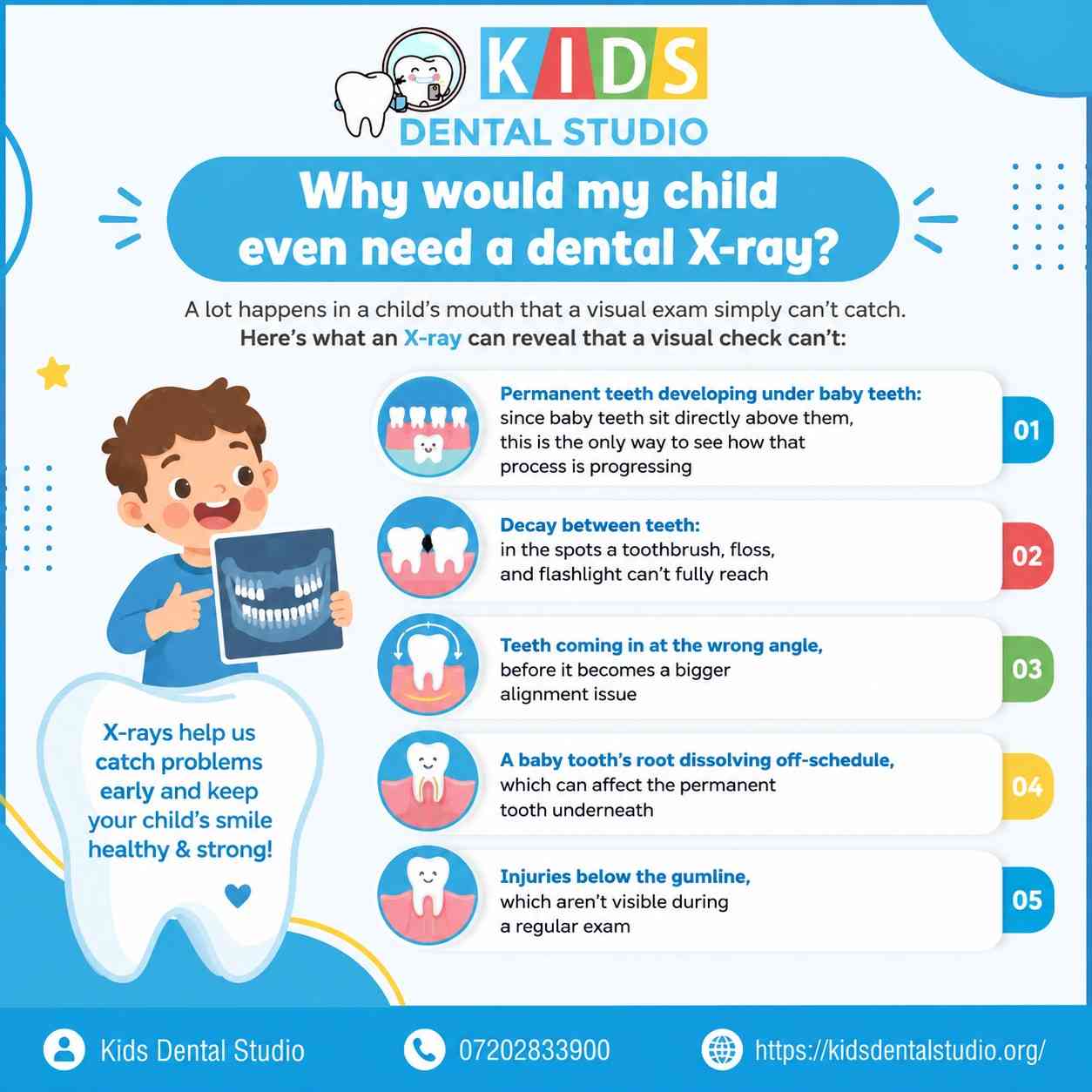 A lot happens in a child’s mouth that a visual exam simply can’t catch. We recently wrote about baby teeth and permanent teeth growing together, and an X-ray is exactly how we track that process before it ever shows up on the surface. Here’s what an X-ray can reveal that a visual check can’t:
- Permanent teeth developing under baby teeth: since baby teeth sit directly above them, this is the only way to see how that process is progressing
- Decay between teeth: in the spots a toothbrush, floss, and flashlight can’t fully reach
- Teeth coming in at the wrong angle, before it becomes a bigger alignment issue
- A baby tooth’s root dissolving off-schedule, which can affect the permanent tooth underneath
- Injuries below the gumline, which aren’t visible during a regular exam
Without that information, some problems only get noticed once they’re already causing pain.
How much radiation does a dental X-ray actually involve?
This is where most of the worry comes from, and it’s worth being precise about it.
- A single dental X-ray, especially with modern digital equipment, involves an extremely small dose of radiation, roughly comparable to the background radiation your child gets just from living on Earth for a few hours to a day
- Digital X-rays (what most modern clinics use) require a fraction of the radiation older film X-rays needed
- The image appears instantly on a screen instead of needing to be developed, so there’s rarely a need to retake a shot because of a technical error
None of this means radiation exposure should be treated casually. It means the actual risk from an occasional, appropriately timed dental X-ray is very low, and that risk has to be weighed against the risk of missing a problem that grows worse the longer it goes undetected.
What safety steps protect my child during an X-ray?
Every X-ray we take follows the same principle dentists are trained in worldwide: use the lowest dose that still gives a clear, useful image, and only take one when there’s a real reason to. In practice, that looks like:
- No fixed schedule: we don’t take X-rays just because a certain amount of time has passed; we take them when your child’s history, symptoms, or risk of decay actually calls for one
- A lead apron that shields the rest of the body during the X-ray, often paired with a thyroid collar
- A narrow, targeted beam, aimed only at the specific area we need to see
- Digital technology, which keeps exposure as low as it can reasonably be while still giving us a usable image
How often will my child actually need one?
This depends entirely on your child:
- A child with healthy teeth, no history of cavities, and good spacing between teeth may only need an X-ray once a year, or sometimes less
- A child who has had cavities before, has crowded teeth, or is at a stage where we’re watching permanent teeth come in may need one more often, but never more often than is actually useful
If your dentist recommends one, it’s worth asking what they’re specifically looking for. A good pediatric dentist should be able to explain that clearly, not just say “it’s routine.”
Conclusion
Dental X-rays aren’t something to fear, but they also shouldn’t be taken on autopilot. When they’re used with a clear reason, modern digital equipment, and proper shielding, the radiation risk to your child is very small, and the information they provide often matters more than that small risk. If your child’s dentist has recommended one and you’d like it explained in plain terms first, that’s a completely reasonable thing to ask for.
Best Pediatric Clinic in Ahmedabad
If you have questions about your child’s upcoming visit or want to understand what an X-ray would actually be checking for, contact us or call us and we’ll walk you through it before the appointment, not just during it.
Frequently Asked Questions
Q: Can I say no to a dental X-ray for my child?
Yes, you can decline, and a good pediatric dentist will discuss the reasoning with you rather than insist. That said, declining means the dentist is working with less information, so it’s worth understanding what you might be missing before you decide.
Q: Are digital X-rays really safer than the older film type?
Yes. Digital X-rays use noticeably less radiation than traditional film X-rays and produce the image immediately, which reduces the chance of needing a repeat shot.
Q: At what age can a child start having dental X-rays?
There’s no fixed age. It depends on the child’s mouth, risk factors, and whether a visual exam has raised a question that only an X-ray can answer. Some children need one earlier than others.
Q: Will my child need to sit still for a long time?
No. A single dental X-ray takes only a few seconds. The bigger challenge with young children is usually holding the small sensor still in the mouth, not the exposure time itself.
Q: Does a dental X-ray hurt?
No. There’s no pain involved. Some children find the small sensor or film slightly uncomfortable to hold in place for a few seconds, but that’s the extent of it.
Leave a reply