
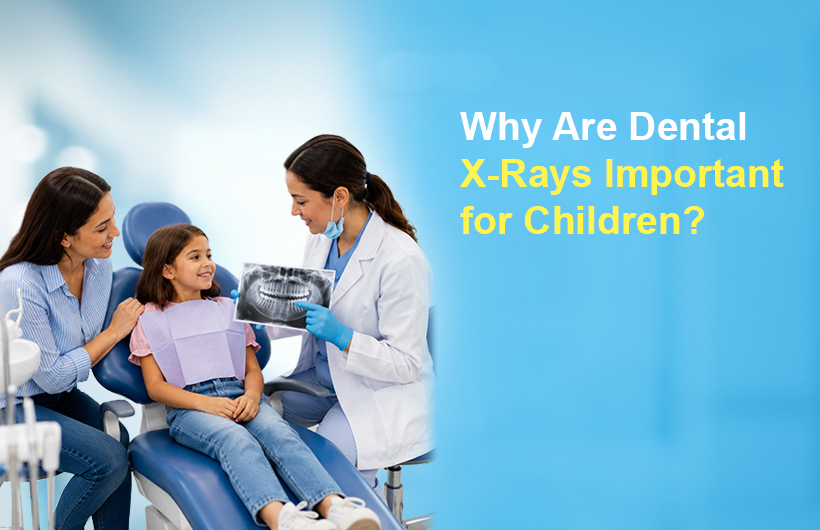
Why Are Dental X-Rays Important for Children?
As a parent, you want every dental visit to be simple and reassuring. So when your child’s dentist recommends an X-ray, it is natural to wonder: is this really necessary? Is it safe?
The short answer is yes, and here is why. A dental X-ray lets your child’s dentist see what is happening inside the teeth and beneath the gums. That information is something no visual exam can give you. In children especially, whose teeth and jaws are still growing, problems can develop silently for months before they show any outward signs.
This guide walks you through exactly what pediatric dental X-rays detect, how safe they are for your child, and when they are actually needed.
What Your Child’s Dentist Can See That You Cannot
During a regular dental checkup, your dentist examines the visible surfaces of your child’s teeth. That covers a lot, but not everything. A large part of every tooth lives below the gumline or between two teeth, where no light and no mirror can reach.
Dental X-rays, also known as dental radiographs, capture detailed images of the teeth, the roots, the jawbone, and the soft tissues around them. They give your dentist a complete picture of your child’s oral health, not just the visible part of it.
For children, this matters even more because so much of dental development happens beneath the surface. Baby teeth care is only part of the story. What lies under those primary teeth, the permanent teeth forming and waiting to erupt, is equally important.
What Do Dental X-Rays Actually Detect in Children?
Hidden Cavities Between Teeth
Cavities that form between teeth, called interproximal cavities, are invisible to the eye. By the time they become visible or start to cause pain, they are already in an advanced stage. An X-ray catches these early, when treatment is simple and quick.
Waiting until a child complains of a toothache means the problem has already been growing for some time. Early detection through an X-ray prevents that from happening.
Tracking Permanent Tooth Development
Your child’s permanent teeth begin forming inside the jaw well before they erupt. An X-ray lets your pediatric dentist monitor this development, confirm that permanent teeth are growing in the right position, and catch any crowding or misalignment early.
Addressing tooth position issues early is far simpler than correcting them later. This is one reason why primary teeth in children matter so much. They guide the path of permanent teeth, and an X-ray helps your dentist ensure that guidance is on track.
Jaw and Bone Health
X-rays also reveal the health of the jawbone and the roots of your child’s teeth. They can detect bone infections, abscesses at the root of a tooth, and early signs of gum disease. These conditions, if left undetected, can develop into painful and expensive problems.
Catching a bone infection at its earliest stage, before pain sets in, is the difference between a minor treatment and a major one.
Are Dental X-Rays Safe for Children?
Yes. This is the question every parent asks, and the answer is clear: modern dental X-rays are safe for children when used appropriately.
How Much Radiation Is Actually Involved?
The radiation from a dental X-ray is extremely low. To put it in perspective, a standard dental X-ray exposes your child to roughly 0.5 to 4 millirems of radiation. The natural background radiation we are all exposed to just from living on Earth is around 620 millirems per year.
A short airplane flight involves comparable radiation. In that context, a dental X-ray is a very small exposure, taken only when it is clinically needed.
Digital X-ray technology, now standard at most pediatric dental clinics, uses up to 90% less radiation than older film X-ray methods. This makes them even safer for young patients.
What Precautions Does a Pediatric Dentist Take?
Your child’s safety is always the priority. At a pediatric dental clinic, the following steps are standard during an X-ray:
- A lead apron covers the body, shielding your child from scattered radiation.
- A thyroid collar protects the thyroid gland, which is particularly important in growing children.
- Digital sensors are used to capture the image quickly, reducing exposure time.
- X-rays are only recommended when there is a clinical reason, not as a routine tick-box at every visit.
When Does Your Child Need Their First Dental X-Ray?
There is no universal age. The American Academy of Pediatric Dentistry recommends that the first X-ray be taken when the back teeth start touching each other closely enough that a visual exam can no longer see between them. For most children this happens around age 3, though it varies.
Your dentist may recommend an earlier X-ray if:
- Your child has a history of tooth decay or frequent cavities.
- There are signs of delayed tooth eruption.
- Your child is experiencing tooth pain.
- There is visible damage to a tooth or concern about a previous filling.
Most children have their first dental X-ray by the time they are 5 or 6 years old, when the permanent teeth begin to erupt.
How Often Should Children Get Dental X-Rays?
The frequency depends on your child’s individual needs. Children with a higher risk of decay may need X-rays every six months. Children with healthy teeth and low cavity risk may only need them every one to two years.
Good baby teeth care at home, meaning regular brushing, limiting sugary foods, and attending dental checkups, directly reduces how often X-rays are necessary. The healthier your child’s teeth, the less frequently the dentist needs imaging to monitor them.
Digital X-Rays: A Safer, Smarter Choice for Kids
At Kids Dental Studio, we use digital X-ray technology for all imaging. Digital X-rays deliver significantly lower radiation doses than traditional film X-rays, produce sharper images, and display results instantly on screen so we can walk you through the findings together during your visit.
Because the process is faster, it is also much more comfortable for children. Less time sitting still, less anxiety, and a clearer result for your dentist.
A Note for Parents
It is completely understandable to have questions whenever your child’s dentist recommends a procedure, no matter how routine. That is good parenting.
Dental X-rays are one of the most important tools in pediatric dentistry. They allow early detection of problems that cannot be seen with the naked eye, support healthy jaw and tooth development, and help us give your child the best care possible.
If you have questions about whether your child needs an X-ray, or concerns about what one involves, please speak with us. We are always happy to explain what we are looking for, what we found, and what it means for your child’s oral health.
FAQs
At what age should my child get their first dental X-ray?
There is no fixed age. Most children have their first X-ray around age 3 to 6, usually when the back teeth start touching closely enough that cavities between them can no longer be spotted visually. Your pediatric dentist will recommend one based on your child’s specific dental development, not a calendar date.
How often does my child need dental X-rays?
It depends on your child’s cavity risk. Children prone to decay may need X-rays every six months. Children with consistently healthy teeth may only need them every one to two years. Good baby teeth care at home, including brushing twice daily and reducing sugar, directly reduces how frequently X-rays are needed.
Are dental X-rays safe for toddlers and young children?
Yes. The radiation from a dental X-ray is extremely low, comparable to the natural background radiation your child is exposed to over just a few days of normal life. Digital X-rays, which are now standard at most pediatric dental clinics, use up to 90% less radiation than older film methods. A lead apron and thyroid collar are always used to further protect your child during imaging.
Can a dentist detect cavities without an X-ray?
A dentist can spot surface cavities during a visual exam, but cavities that form between teeth or beneath the gumline are invisible without an X-ray. By the time these hidden cavities cause pain or become visible, they are often already in an advanced stage. Early detection through an X-ray means simpler, less invasive treatment for your child.
Do milk teeth need X-rays? They will fall out anyway.
Yes, primary teeth in children absolutely need monitoring. Milk teeth hold space in the jaw and guide the permanent teeth that grow below them. An untreated cavity or infection in a baby tooth can damage the developing permanent tooth underneath it. Losing a baby tooth too early due to decay can also cause spacing and alignment problems later. X-rays help protect both the tooth you can see and the one that is still on its way.
Will the X-ray hurt my child?
Not at all. Dental X-rays are completely painless. Your child sits still for a few seconds while the image is captured. The process is quick, and with digital X-rays, the result appears on screen almost immediately. Many children find it more interesting than uncomfortable.
Can I be in the room with my child during the X-ray?
In most cases, yes, especially for younger or anxious children. Your presence helps them feel calm and cooperative. The dental team will give you a lead apron to wear as well. Just let the clinic know beforehand if you would like to stay with your child during imaging.
Leave a reply